
美国蜂蜜产量与蜂群数量Honey production and honey producing colonies – America
AI 估评 7.5 分查看四维评分详情
四个维度等权计分,均值 7.5,按半分档展示。AI 估评供学习参考。
任务完成度 TA7 / 9
两图核心排名及不完全成比例的关系准确,五州均涉及;但威斯康星蜂蜜写约500万而图为600万,中间三州产量仅说相近而缺数据支持。
档位依据:清晰概述和主要比较达到7档;局部数字误差和支持不充分限制8档。
查看评分证据
the relationship was not perfectly proportional across all states
合理整合两图关系。
yielded only about 5 million pounds of honey
图示约600万磅,应修正。
- 题图证据
已看蜂群柱图,单位千群:北达科他350,南达科他225,蒙大拿130,明尼苏达约125,威斯康星约60。
- 题图证据
已看产量柱图,单位百万磅:北达科他约26,南达科他11,蒙大拿约10.5,明尼苏达10,威斯康星6。
改进建议
- 补南达科他约1100万、明尼苏达1000万,修正威斯康星600万。
连贯与衔接 CC7 / 9
概述后比较领先及中间各州,再介绍末位,逻辑清楚;末句再次重复南达科他蜂群与产量不成比例,细节分组稍松散。
档位依据:清晰组织达到7档;重复总结和分组可更紧凑以达8档。
查看评分证据
South Dakota came in second for colonies
自然从最高州转第二位。
Notably, although South Dakota had nearly double the number of colonies
此前已作同一对比,结尾重复。
改进建议
- 把所有中间州跨图比较放在同一段,删去末尾重复判断。
词汇资源 LR8 / 9
output、yielded、proportional、substantial margin等搭配准确,量和关系表达灵活;boasted略带修辞但不妨碍报告。
档位依据:较宽词汇范围与精确搭配达到8档;可更中性凝练以接近9档。
查看评分证据
the highest among the five states by a substantial margin
差距概括自然。
a lower scale of beekeeping activity
与规模相关的表达清楚。
改进建议
- 以had替代boasted,保持客观统计语气。
语法范围与准确性 GRA8 / 9
比较结构、让步从句和each of which关系从句准确,长句标点受控;少量概述现在时与细节过去时切换不影响理解。
档位依据:多样结构、绝大多数句无误符合8档;时态统一可进一步精炼。
查看评分证据
each of which had significantly fewer colonies
关系从句指代和谓语准确。
although South Dakota had nearly double the number of colonies compared to Minnesota or Montana
让步与比较结构清楚。
改进建议
- 统一用过去时描述2006统计,图表说明句可保留现在时。
评分日期:2026-10-23 · 评分规则:IELTS 写作公开评分标准(2023 年 5 月版)
作文题目
来源页题目,与同页选定答案配套;未核为实际考试真题
The bar charts below provide information about honey production and honey producing colonies in the five American states in 2006.
Summarise the information by selecting and reporting the main features, and make comparisons where relevant.
You should write at least 150 words.
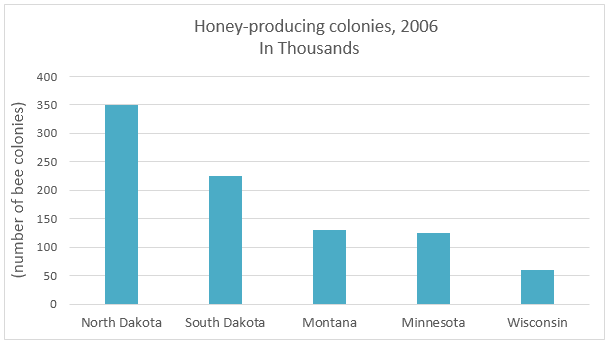
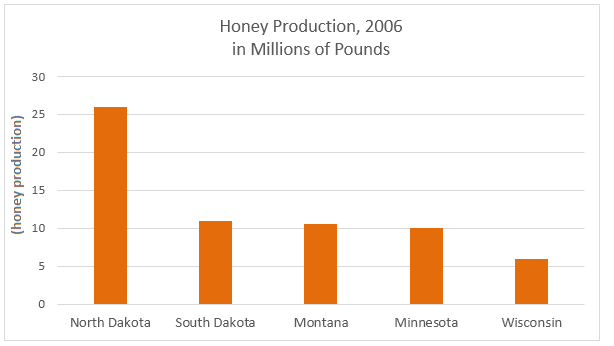
The bar charts compare the number of honey-producing bee colonies with the amount of honey produced in five U.S. states in 2006: North Dakota, South Dakota, Montana, Minnesota, and Wisconsin.
Overall, North Dakota clearly dominates in both the number of colonies and honey output, while Wisconsin ranks lowest in both. Though there was a correlation between the number of bee colonies and the amount of honey a state produced, the relationship was not perfectly proportional across all states.
In 2006, North Dakota boasted about 350,000 honey-producing colonies and produced over 25 million pounds of honey – the highest among the five states by a substantial margin. South Dakota came in second for colonies, with around 225,000, yet its honey production was similar to Montana and Minnesota, each of which had significantly fewer colonies (roughly 130,000 in Montana and 120,000 in Minnesota).
Meanwhile, Wisconsin had the smallest number of colonies, just over 50,000, and yielded only about 5 million pounds of honey, indicating a lower scale of beekeeping activity. Notably, although South Dakota had nearly double the number of colonies compared to Minnesota or Montana, its honey production did not reflect that proportional increase.
- 文章身份
- 机构教研范文
- 题目来源
- 教学题目