
不同年龄段的阅读媒介选择Reading formats by age group
作文题目
发布方明确说明为该站原创教学题目,未取自实考题/官方练习题。
The task. The chart below shows the percentage of adults in four age groups who read a printed book, an e-book or an audiobook in one year. Summarise the information by selecting and reporting the main features, and make comparisons where relevant.
Age group | Printed book | E-book | Audiobook
18–29 | 52% | 41% | 38%
30–44 | 58% | 39% | 31%
45–59 | 61% | 28% | 19%
60+ | 66% | 17% | 9%
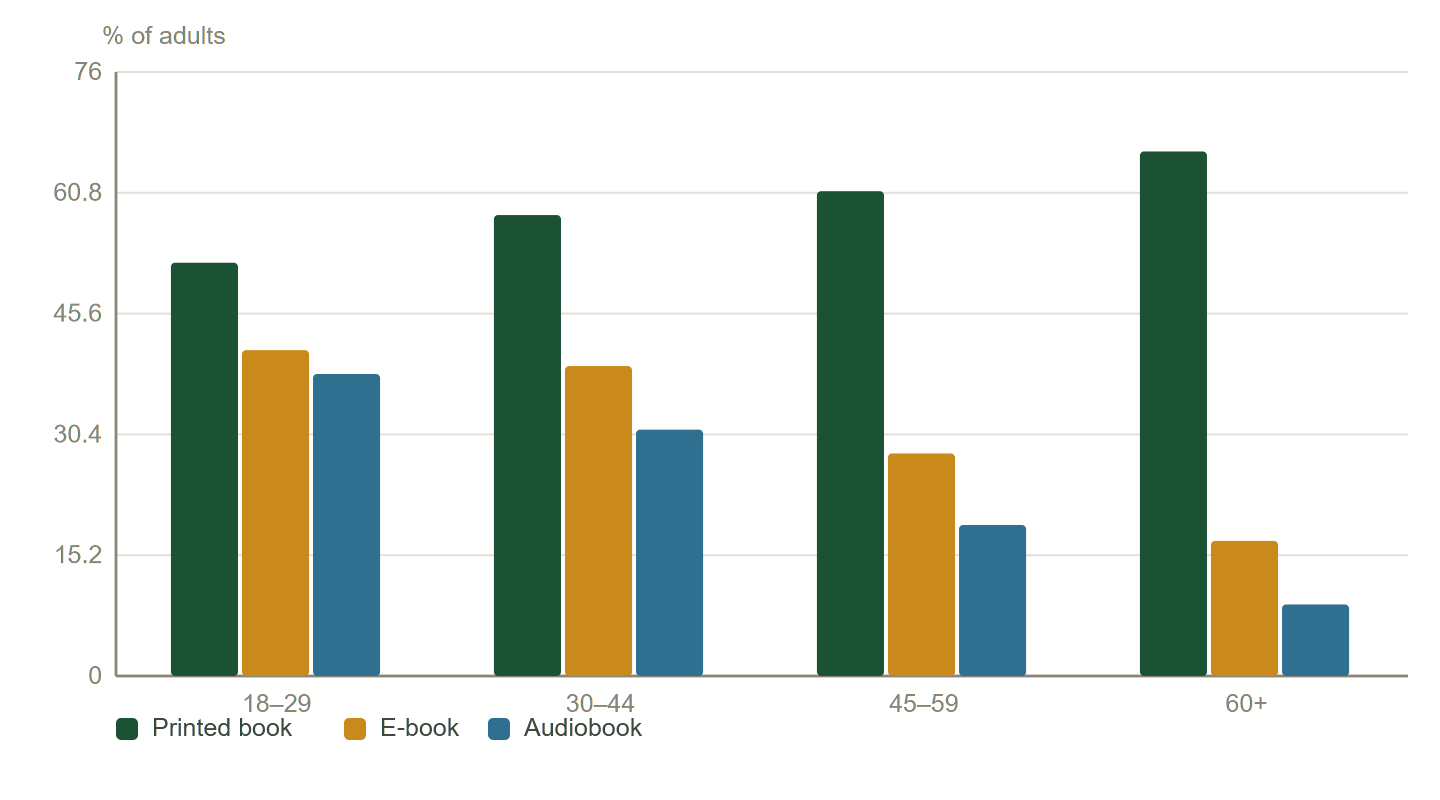
The chart shows what proportion of adults in each of four age groups reported using three reading formats over the course of a year.
Overall, printed books were the most widely used format in every age group, and the only one whose popularity increased with age. The two digital formats behaved in the opposite way, and the gap between the youngest and oldest groups was far wider for audiobooks than for anything else.
Printed reading rose modestly across the age range, from 52% of 18-to-29-year-olds to 66% of those over 60 — a difference of 14 percentage points. E-book use moved in the reverse direction, though less evenly: it was almost unchanged between the two youngest groups, at 41% and 39%, before dropping to 28% and then to 17%.
Audiobooks showed the steepest decline of all. More than a third of the youngest group used them, compared with fewer than one in ten of the oldest — a fall of 29 percentage points, and by some margin the largest difference between any two groups on the chart.
- 文章身份
- 机构教研范文
- 题目来源
- 原创教学练习题