
大学男女教职员工比例Male and female academic staff members of a university
AI 估评 8 分待复核查看四维评分详情
四个维度等权计分,均值 7.75,按半分档展示。AI 估评供学习参考。
任务完成度 TA7 / 9
主要性别差异及极值识别正确;工程女性18%改成15%、商科女性35%并入科学38%,似按互补推算,未忠实原图标签;教育约70可接受近似。
档位依据:清楚概述和主要分类支持7档;两处数字替换限制8档。
查看评分证据
the corresponding female proportion at just 15%
原图工程女性18%,不能因男85自行补15。
Science and Business faculties each have a clear male majority, with 62% of staff being male and about 38% female
科学女性38%,商科女性35%,不应并为相同值。
- 题图证据
已看柱图女/男标签:艺术58/42、商科35/62、教育72/25、工程18/85、法律40/60、医学50/49、科学38/62;若干总和不等于100但标签清晰。
改进建议
- 分别保留工程18%和商科35%,原图不一致应注明而非自行调整。
连贯与衔接 CC8 / 9
男性占多学院与女性占多及医学分段,对比组织清楚,指代自然。
档位依据:分组及衔接达到8档;末尾评价句稍冗余,未达9档精练。
查看评分证据
By contrast, female staff members outnumber their male counterparts
从男占多转入女占多自然。
In Medicine, gender representation is almost balanced
以近等例外收束。
改进建议
- 保留分类比较,省去末尾价值评价。
词汇资源 LR8 / 9
parity、predominance、representation等精确丰富;equitable把相等误延伸为公平评价。
档位依据:范围和流畅性达到8档;价值色彩影响9档语义精确。
查看评分证据
gender proportions closer to parity
准确表达接近相等。
the most equitable distribution
比例相等不能直接证明公平,宜用balanced。
改进建议
- 用most balanced替代equitable,保持客观描述。
语法范围与准确性 GRA8 / 9
with结构、分词、对比和关系从句准确,多数句无误;个别过去与现在描述切换。
档位依据:结构广泛且控制好达到8档;时态统一性仍可改进以达9档。
查看评分证据
making it the most male-dominated area
分词结构准确。
seven out of ten staff members were women
分数主语及过去时准确,但周围多用现在时。
改进建议
- 统一描述2016数据所用时态。
评分日期:2026-10-23 · 评分规则:IELTS 写作公开评分标准(2023 年 5 月版)
作文题目
来源页题目,与同页选定答案配套;未核为实际考试真题
The graph shows the percentage of male and female academic staff members across the faculties of a major university in 2016.
Summarise the information by selecting and reporting the main feature, and make comparisons where relevant.
You should write at least 150 words.
Academic staff percentages in faculties, by gender, 2016
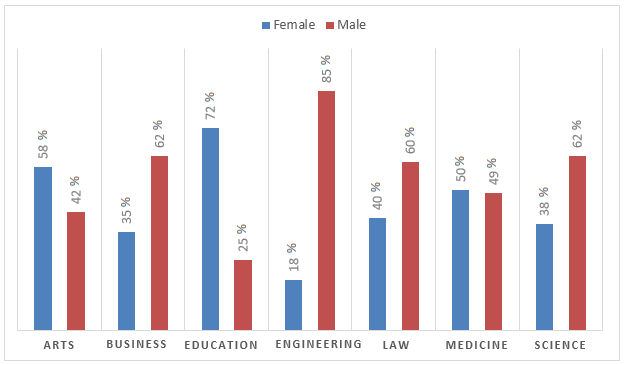
题目材料说明:来源题图中部分男女百分比合计不为 100%;图中数值照原样展示。
The column graph compares the proportions of male and female academic staff members across seven faculties at a prominent university in 2016.
Overall, there are noticeable gender disparities among the faculties. Men dominate most academic fields, particularly in technical and commercial subjects, whereas women are more prevalent in disciplines related to the arts and education. Only the medicine faculty had gender proportions closer to parity.
In detail, the faculty of Engineering has the highest percentage of male staff at approximately 85%, with the corresponding female proportion at just 15%, making it the most male-dominated area. Similarly, the Science and Business faculties each have a clear male majority, with 62% of staff being male and about 38% female. The Law faculty also shows a male predominance, though the gap is slightly narrower, with roughly 60% male and 40% female academics.
By contrast, female staff members outnumber their male counterparts in the faculties of Arts and Education. In the Education faculty, seven out of ten staff members were women. The Arts faculty also has a higher proportion of female staff, at about 58%, compared with 42% male. In Medicine, gender representation is almost balanced, with approximately 50% male and 50% female academic personnel, indicating the most equitable distribution among all faculties.
- 文章身份
- 机构教研范文
- 题目来源
- 教学题目