
四个亚洲国家的城市人口比例Percentage of the population in four Asian countries living in cities
AI 估评 7 分查看四维评分详情
四个维度等权计分,均值 6.75,按半分档展示。AI 估评供学习参考。
任务完成度 TA6 / 9
覆盖四国起终点及菲律宾回落,但概述仅称全部快速上升,没有呈现显著差异;多项预测和末值较粗,漏印尼超过菲律宾这一主要变化。
档位依据:相关概述和数字达到6档;关键差异与交叉未充分突出,未达7档。
查看评分证据
the ratio of city-dwellers rapidly increased over the period
泰国增幅较缓、菲律宾曾降,概括过笼统。
It is expected to reach about 60% by 2040.
印尼预测约64%,同时已成为第二高国家未强调。
- 题图证据
已看折线:1970菲32、马30、泰18、印14%;2020约45、76、33、52%;2040预测56、83、50、64%。菲律宾1990约48后回落,印尼2010与菲约43相交。
改进建议
- 概述加入马来西亚领先、印尼追赶和菲律宾波动,细化2040预测值。
连贯与衔接 CC7 / 9
起点单段、后续逐国展开,能跟随时间变化;末段过长,预测和历史穿插,比较被分散。
档位依据:顺序总体清楚支持7档;分组及冗余不够精练,未达8档。
查看评分证据
Over the next decades, Malaysia saw a rapid rise
清楚从起点转入发展。
Indonesia, on the other hand, expanded from its initial low base
转国明确,但随后仍重复起点与终点模式。
改进建议
- 将持续快速增长的马来西亚与印尼成组,菲律宾和泰国另成组。
词汇资源 LR7 / 9
urbanised、volatile trend、rebound等词有效;counties拼写误写countries,ratio及city-dwellers重复较多。
档位依据:范围及灵活性达到7档;拼写与表达精度限制8档。
查看评分证据
in all four given counties
counties与国家含义不符。
Predictions suggest a gradual rebound
反弹表达自然。
改进建议
- 纠正countries,统一用urban population share表示指标。
语法范围与准确性 GRA7 / 9
关系、预测被动及比较句基本准确;2020历史叙述突然用will,时态控制有局部问题。
档位依据:频繁正确复杂句支持7档;历史与预测时态不稳限制8档。
查看评分证据
about 50% by 2020, when half of its total population will live in cities
2020应保持过去时,且重复同一信息。
it is projected to reach a point where almost half of its population will live in city areas
预测结构和关系从句准确。
改进建议
- 明确区分2020以前的过去时和2030、2040的预测时态。
评分日期:2026-10-23 · 评分规则:IELTS 写作公开评分标准(2023 年 5 月版)
作文题目
来源页题目,与同页选定答案配套;未核为实际考试真题
The graph below gives information about the percentage of the population in four Asian countries living in cities from 1970 to 2020, with predictions for 2030 and 2040.
Summarise the information by selecting and reporting the main features, and make comparisons where relevant.
Write at least 150 words.
Percentage of population living in cities
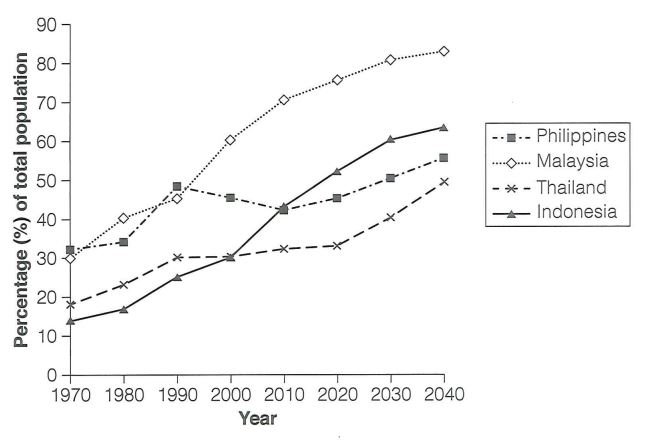
The line graph illustrates the proportion of people living in cities in four Asian countries from 1970 to 2020, along with predictions for 2030 and 2040.
Overall, in all four given counties, the ratio of city-dwellers rapidly increased over the period, and it is predicted to rise even further in the coming decades.
In 1970, both Malaysia and the Philippines had about 30 percent of their populations living in cities, whereas just under one-fifth of the population in Thailand lived in urban areas. Indonesia was the least urbanised in terms of its population ratio in cities, with roughly 12 to 13 per cent.
Over the next decades, Malaysia saw a rapid rise in its urban population ratio, and the figure reached approximately 75% in 2020. The forecasts suggest it will climb to around 85% by 2040, making it the most urbanised country among the four. Indonesia, on the other hand, expanded from its initial low base of city-dwellers to about 50% by 2020, when half of its total population will live in cities. It is expected to reach about 60% by 2040. The Philippines experienced a more volatile trend as its urban share of population rose to around 50% in 1990, then fell back in the following years, fluctuating until 2020 at roughly the mid‑40s. Predictions suggest a gradual rebound, bringing the figure closer to 60% by 2040. Finally, the ratio of city dwellers in Thailand was just 30% in 2020, and it is projected to reach a point where almost half of its population will live in city areas.
- 文章身份
- 机构教研范文
- 题目来源
- 教学题目