
1992年英国就业结构Employment patterns in Great Britain in 1992
AI 估评 8 分查看四维评分详情
四个维度等权计分,均值 7.75,按半分档展示。AI 估评供学习参考。
任务完成度 TA7 / 9
总体手工与非手工差异、男女最大类别和文职差距清楚;男性工艺26%误写24%,男性其他手工虽强调较多却缺24%数据,人数词outnumbered不符合比例口径。
档位依据:主要特征和多项准确数字支持7档;局部错读与口径不精确限制8档。
查看评分证据
roughly 27% of female workers compared with 24% of males
男性工艺应26%。
Men were far more likely to be employed in other manual work, compared with only 3% among females.
差异正确,缺男性24%的支撑。
- 题图证据
已看双饼图,女/男:工艺27/26,一般劳工1/2,其他手工3/24,管理专业29/36,文职31/6,其他非手工9/6,单位%。
改进建议
- 纠正工艺26%,补其他手工男性24%,用higher proportion替代outnumbered。
连贯与衔接 CC8 / 9
手工和非手工分段分类明确,各段直接进行男女比较,转折和指代自然。
档位依据:良好分组与衔接达到8档;段内重复比较句框架,尚非9档更娴熟整合。
查看评分证据
In terms of manual occupations, clear gender differences can be observed.
先设定清楚分类。
Turning to non-manual employment
明确转入另一组。
改进建议
- 可把差异最大和几乎相等的类别合并说明,减少同型列举。
词汇资源 LR8 / 9
disparity、concentrated、heavily represented等范围宽、搭配自然;outnumbered将比例误作人数。
档位依据:流畅灵活词汇支持8档;单处指标语义不精确限制9档。
查看评分证据
The most striking disparity
准确突出文职差异。
women slightly outnumbered men
只有比例数据,人数动词不够精确。
改进建议
- 改为the female share was slightly higher。
语法范围与准确性 GRA8 / 9
对比、关系从句、分词结构准确,多数句无误,比例信息组织清晰。
档位依据:广泛准确结构符合8档;部分相似百分比从句仍可更灵活以接近9档。
查看评分证据
where women were heavily represented, accounting for about 31%
关系与分词结构准确。
standing at approximately 2% for men and 1% for women
分词结果与并列比例正确。
改进建议
- 以合计手工份额比较句丰富结构,同时保持名词和单位一致。
评分日期:2026-10-23 · 评分规则:IELTS 写作公开评分标准(2023 年 5 月版)
作文题目
来源页题目,与同页选定答案配套;未核为实际考试真题
The two pie charts below show some employment patterns in Great Britain in 1992.
Summarize the information by selecting and reporting the main features, and make comparisons where relevant.
You should write at least 150 words.
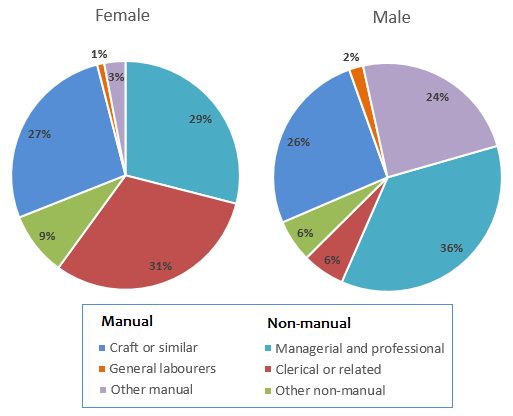
The two pie charts compare the employment patterns of male and female workers in Great Britain in 1992 across six occupational categories, which are grouped into manual and non-manual jobs.
Overall, while men were considerably more likely than women to work in manual occupations, women dominated several non-manual roles. The largest single category for males was managerial and professional work, whereas clerical or related jobs were most common among females.
In terms of manual occupations, clear gender differences can be observed. Men were far more likely to be employed in other manual work, compared with only 3% among females. By contrast, women slightly outnumbered men in craft or similar occupations, making up roughly 27% of female workers compared with 24% of males. Employment as general labourers was minimal for both sexes, standing at approximately 2% for men and 1% for women.
Turning to non-manual employment, males were more concentrated in managerial and professional roles, with around 36% working in this sector, compared to approximately 29% of females. The most striking disparity, however, is evident in clerical or related occupations, where women were heavily represented, accounting for about 31% of female employment, while only 6% of men worked in this area. Other non-manual jobs employed a relatively small proportion of both genders, women at around 9%, compared with 6% for men.
- 文章身份
- 机构教研范文
- 题目来源
- 教学题目