
学生外语熟练程度Students who are proficient in a foreign language
AI 估评 7.5 分查看四维评分详情
四个维度等权计分,均值 7.25,按半分档展示。AI 估评供学习参考。
任务完成度 TA6 / 9
覆盖六国及性别总体差异,印度高值与泰国例外清楚;越南女性56%误为66%,中国两性被笼统写在30至40%,且中国最低的概述忽略泰国女性更低。
档位依据:相关概述和部分正确比较满足6档;多国数据及最低值错误使其未达7档准确性。
查看评分证据
about 66% of women can speak another language
越南女性实际约56%。
both Russia and China register comparatively low figures, with second language proficiency rates for males and females hovering roughly between 30–40%
中国男性约17%和俄罗斯女性约43%不在该范围。
- 题图证据
已查看柱图:男女约值中国17/30、罗马尼亚42/65、泰国31/27、印度56/67、俄罗斯35/43、越南37/56,单位%。
改进建议
- 逐项核对越南和中国数值,区分男女各自的最低国家。
连贯与衔接 CC8 / 9
高水平国家先述,泰国例外和较低国家后述,概述、分组和转折易跟随。
档位依据:逻辑分组与连贯性符合8档;末句多次with串联,仍可精炼以接近9档。
查看评分证据
Vietnam also exhibits a significant gender gap
衔接前述高女性比例组。
In contrast, Thailand deviates from the general pattern
转入例外清楚。
改进建议
- 将末句中国和俄罗斯拆成直接对比,减少重复with结构。
词汇资源 LR7 / 9
competent、counterparts、gender gap和trail等词汇足够灵活;ratio of such learners不够自然,proficient与fluent的替换略宽。
档位依据:范围支持7档;图表量词和能力概念的精度尚未达到8档。
查看评分证据
while men trail at 37%
简明表达较低比例。
China shows the lowest ratio of such learners
ratio搭配不如proportion准确。
改进建议
- 用proportion of proficient students保持概念一致。
语法范围与准确性 GRA8 / 9
分词、比较、while对照和with结构多数准确,复杂句控制稳定。
档位依据:广泛准确结构符合8档;最后一句重复附加结构,灵活性和精炼度尚非9档。
查看评分证据
approximately 65% of females, but only around 40% of males having skills in a second language
with框架中的并列分词结构可读。
while men trail at 37%
对比从句准确。
改进建议
- 缩短末句重复的with附加结构。
评分日期:2026-10-23 · 评分规则:IELTS 写作公开评分标准(2023 年 5 月版)
作文题目
来源页题目,与同页选定答案配套;未核为实际考试真题
The bar charts below provide information about percentages of students who are proficient in a foreign language in different countries.
Summarise the information by selecting and reporting the main features, and make comparisons where relevant.
You should write at least 150 words.
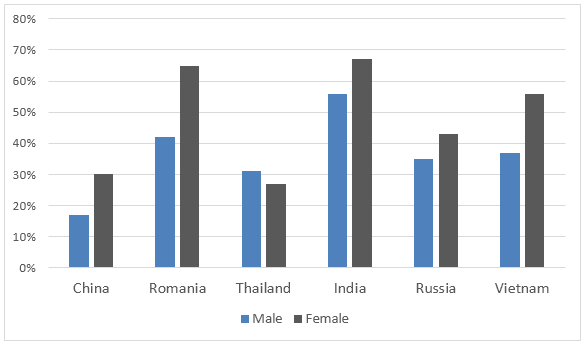
The bar chart compares the percentages of male and female students who are proficient in a foreign language across six countries: China, Romania, Thailand, India, Russia, and Vietnam.
As a general trend, in every country except Thailand, a higher proportion of female students is competent in a second language than their male counterparts. India and Romania stand out with the highest proficiency rates for both genders, while China shows the lowest ratio of such learners.
In India, about 68% of females are fluent in a foreign language, compared with roughly 56% of male students. Romania follows closely, with approximately 65% of females, but only around 40% of males having skills in a second language. Vietnam also exhibits a significant gender gap: about 66% of women can speak another language, while men trail at 37%.
In contrast, Thailand deviates from the general pattern, and around 30% of male students are language-proficient compared with about 28% of females. Meanwhile, both Russia and China register comparatively low figures, with second language proficiency rates for males and females hovering roughly between 30–40%, with China having the smallest share of such students.
- 文章身份
- 机构教研范文
- 题目来源
- 教学题目