
英国儿童在年轻人口中的占比Children as a percentage of the young population in the United Kingdom
AI 估评 7.5 分查看四维评分详情
四个维度等权计分,均值 7.5,按半分档展示。AI 估评供学习参考。
任务完成度 TA7 / 9
四组轨迹和最大份额转换清楚,起止和峰谷基本准确;概述称最小组稳降忽略最初上升,15至19岁末值接近起点的概括低估了1.2个百分点差距。
档位依据:清楚概述和数据支持7档;两处趋势概括不够精确限制8档。
查看评分证据
the youngest children (0-4) steadily declined in their share
实际上先升至1992年再下降,正文虽补充仍与概述不一致。
ended roughly where it started, close to 25%
该组起点约26.2%,末值25%,并非恢复至原水平。
- 题图证据
已查看折线:0至4岁约25.9至1992的26.5后降23.5;5至9岁24.6至1997的26.2后25.2;10至14岁23.2持续升26.3;15至19岁26.2降至1994的23.1后回25。
改进建议
- 概述写最小组先升后总体下降,说明最大年龄组只部分恢复。
连贯与衔接 CC8 / 9
总体分组和时间推进清楚,In contrast及Meanwhile有效区分持续变化与反转组。
档位依据:易读组织和衔接符合8档;概述与细节的先升后降关系可更一致以达9档。
查看评分证据
During the first two years
清楚定位最初小幅上升。
Meanwhile, the proportion of children aged 5-9 peaked
自然进入另一个变化类型。
改进建议
- 同步概述和细节的阶段划分,避免读者再修正前面印象。
词汇资源 LR7 / 9
cohorts、divergence、bottoming out等范围充分;infants指全部0至4岁不精确,embarking on a decline较生硬。
档位依据:有较强表达变化能力支持7档;年龄及趋势搭配精度限制8档。
查看评分证据
infants (0-4)
infants通常不覆盖整个0至4岁组。
before embarking on a gradual decline
比例作embark的主语略不自然。
改进建议
- 用children aged 0–4和then declined保持年龄及趋势表达精确。
语法范围与准确性 GRA8 / 9
时间从句、分词、对照和并列谓语准确,时态整体稳定,多数句无误。
档位依据:结构丰富且准确符合8档;有些多阶段长句仍可精炼,未充分体现9档。
查看评分证据
before embarking on a gradual decline, ending the period at slightly above 23%
分词结构和逻辑主语一致。
but then decreased somewhat to finish at slightly more than 25% in 2001
并列谓语与目的式结果结构可读。
改进建议
- 可通过明确主句分开峰值及回落阶段,使长句更紧凑。
评分日期:2026-10-23 · 评分规则:IELTS 写作公开评分标准(2023 年 5 月版)
作文题目
来源页题目,与同页选定答案配套;未核为实际考试真题
The graph shows children by age group as a percentage of the young population in the United Kingdom between 1990 and 2001.
Summarise the information by selecting and reporting the main features, and make comparisons where relevant.
You should write at least 150 words.
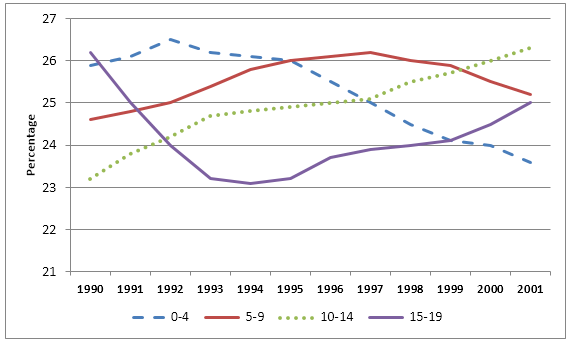
The line graph illustrates how the proportions of four age cohorts (0-4, 5-9, 10-14, and 15-19) changed as a percentage of the young population in the UK over the period from 1990 to 2001.
Overall, there is a clear divergence in trends among the age groups: the youngest children (0-4) steadily declined in their share, while the 10–14 age bracket experienced a continuous rise and ultimately became the largest proportion of the young population by the end of the period. The 5-9 and 15-19 groups exhibited more modest fluctuations.
In 1990, infants (0-4) and older adolescents (15-19) each made up just over a quarter of the youth demographic. Children aged 5 to 9 accounted for approximately 24%, and 10–14 year-olds were the smallest group at 23%. During the first two years, the percentage of 0–4-year-olds briefly increased before embarking on a gradual decline, ending the period at slightly above 23%. In contrast, the 10-14 cohort rose steadily throughout the decade and approached the mid-26% range by 2001.
Meanwhile, the proportion of children aged 5-9 peaked around the mid-1990s (1995-1997) at just over 26%, but then decreased somewhat to finish at slightly more than 25% in 2001. The 15-19 age group dropped in the early 1990s, bottoming out around 1994, then made a modest recovery and ended roughly where it started, close to 25%.
- 文章身份
- 机构教研范文
- 题目来源
- 教学题目