
加纳家庭的冰箱电力和用水情况Access to refrigerator, electricity and water in Ghana
AI 估评 7.5 分查看四维评分详情
四个维度等权计分,均值 7.5,按半分档展示。AI 估评供学习参考。
任务完成度 TA7 / 9
组间差异和低收入组部分下降概述正确,多数数字准确;非贫困组冰箱、水只有定性描述,且把非贫困直接叫富裕或富人,超过资料分类。
档位依据:清楚概述与主要趋势满足7档;分类偏移及较少支撑使其未达8档。
查看评分证据
non-poor or affluent households made clear gains
非贫困不必然等于富裕。
Refrigerator ownership among this wealthier group likewise improved over time
正确方向但遗漏24至37%的显著变化。
- 题图证据
已查看柱图,极贫/贫困/非贫困依次:冰箱3/11/24至3/7/37;电力48/57/73至34/48/85;水55/69/76至57/69/80,单位%。图注水为私人管道、邻居私人来源或公共管道。
改进建议
- 保留non-poor原分类,并补其冰箱24至37%、水76至80%的数据。
连贯与衔接 CC8 / 9
按贫困组分段,每段对照前后,末段回到组间差距;组织清楚、指代大体稳定。
档位依据:分组和衔接管理符合8档;末尾重复差距概述,尚非9档的精练管理。
查看评分证据
Among the “poor” category (just above the very poor)
明确转组并解释分类。
As the rich gained more in terms of basic utilities, the poorest either stagnated or lost ground in certain areas.
结尾重申前文差距,略重复。
改进建议
- 用一项最大差距变化收束,代替重复概述。
词汇资源 LR7 / 9
amenities、deteriorated、stagnated等范围充分;affluent/rich不忠于分类,more promising偏评价。
档位依据:有灵活表达支持7档;语义和客观性不够稳定,未达8档。
查看评分证据
Water access for this group was more promising
promising加入预测性评价。
the poorest either stagnated or lost ground
简洁表达变化,但可更直接写设施可及比例。
改进建议
- 用increased slightly等客观描述,避免把收入分类扩展为富人。
语法范围与准确性 GRA8 / 9
关系从句、对照和让步结构准确,句子形式丰富,标点良好。
档位依据:范围和多数无误句达到8档;部分句反复主句加while,未充分体现9档灵活性。
查看评分证据
even though nearly 48% of them were connected to electricity
让步和被动结构正确。
while their water access also increased slightly
对比从句准确。
改进建议
- 在保持准确性基础上,把同组设施变化合为有明确比较关系的句子。
评分日期:2026-10-23 · 评分规则:IELTS 写作公开评分标准(2023 年 5 月版)
作文题目
来源页题目,与同页选定答案配套;未核为实际考试真题
The graph below shows the percentage of households, grouped by poverty, on the basis of access to refrigerator, electricity and water in Ghana for the year 1991/1992 to 1998/1999.
Summarise the information by selecting and reporting the main features, and make comparisons where relevant.
You should write at least 150 words.
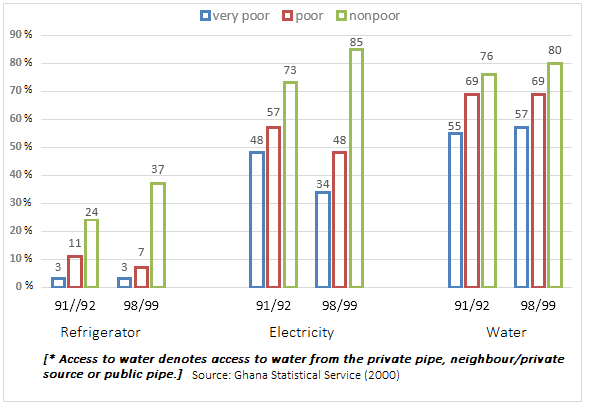
The bar chart illustrates the proportion of Ghanaian households, classified by poverty status, that had access to electricity, refrigerators, and water in 1991/1992 compared with 1998/1999.
Overall, non-poor households enjoyed far greater access to all three basic amenities than very poor or poor families, while in some cases, access for the lower-income groups actually declined over the period.
In the early 1990s, only about 3% of the very poor had refrigerators, even though nearly 48% of them were connected to electricity. Interestingly, by 1998/99, that figure fell sharply to around 34%. Water access for this group was more promising as it increased modestly from roughly 55% to 57%.
Among the “poor” category (just above the very poor), refrigerator access dropped from 11% to 7% over time. Their electricity connection also deteriorated slightly, but water access remained stable at roughly 69% throughout the period.
In contrast, non-poor or affluent households made clear gains. Access to electricity rose from around 73% to 85% in seven years, while their water access also increased slightly. Refrigerator ownership among this wealthier group likewise improved over time, reflecting a widening inequality. As the rich gained more in terms of basic utilities, the poorest either stagnated or lost ground in certain areas.
- 文章身份
- 机构教研范文
- 题目来源
- 教学题目