
澳大利亚家庭能源用途How energy is used in an average Australian household
AI 估评 7.5 分查看四维评分详情
四个维度等权计分,均值 7.5,按半分档展示。AI 估评供学习参考。
任务完成度 TA6 / 9
覆盖六项并有清楚的能耗与排放差异概述;但将其他电器称最大排放来源,与热水32%矛盾,15%与28%的精确标签又写成略低及高于,关键排序不准确。
档位依据:概述和充分数字支持6档;最大来源错误使其未达7档的整体准确内容。
查看评分证据
making it the single largest contributor among all categories
指其他电器28%,实际热水32%最大。
heating accounts for the biggest share of energy use at about 42%, yet it produces only around 15%
供暖的跨图对比准确。
- 题图证据
已查看两饼图,能耗/排放分别:供暖42/15、热水30/32、冷藏7/14、其他电器15/28、照明4/8、制冷2/3,单位%。
改进建议
- 将其他电器改为第二大排放项,并直接写15%和28%。
连贯与衔接 CC8 / 9
每类能耗与排放成对呈现,转入小用能项目后给实例,最后冷却补充收束,阅读轻松。
档位依据:关系与衔接管理符合8档;大细节段包含全部项目,进一步分组可接近9档。
查看评分证据
By contrast, household appliances such as refrigeration, lighting and other electrical equipment use far less energy
有效从供暖组转向设备组。
Lighting follows a similar pattern
自然承接冷藏的比例关系。
改进建议
- 将供暖热水与设备照明分段,突出不同排放关系。
词汇资源 LR8 / 9
disproportionately、accounts for、responsible for等表达灵活,图表词汇范围宽;surprisingly带轻微主观色彩。
档位依据:词汇控制达到8档;程度和评价词可更精确以达到9档。
查看评分证据
create a disproportionately high amount of greenhouse gas emissions
准确表达相对能耗的排放关系。
generate surprisingly high emissions
surprisingly带不必要的主观评价。
改进建议
- 删去surprisingly,用higher shares of emissions保持客观。
语法范围与准确性 GRA8 / 9
让步、对照、分词和并列比较结构准确,句间和句内标点良好,多数句无误。
档位依据:宽泛准确结构支持8档;后段多次同型比较,灵活性尚非9档。
查看评分证据
although room and water heating consume the largest shares of energy
让步结构准确。
consuming around 4% but creating nearly 8% of emissions
并列分词与逻辑主语一致。
改进建议
- 用倍数或相差百分点的结构丰富连续的消耗与排放比较。
评分日期:2026-10-23 · 评分规则:IELTS 写作公开评分标准(2023 年 5 月版)
作文题目
来源页题目,与同页选定答案配套;未核为实际考试真题
The first chart below shows how energy is used in an average Australian household. The second chart shows the greenhouse gas emissions which result from this energy use.
Summarise the information by selecting and reporting the main features, and make comparisons where relevant.
Write at least 150 words.
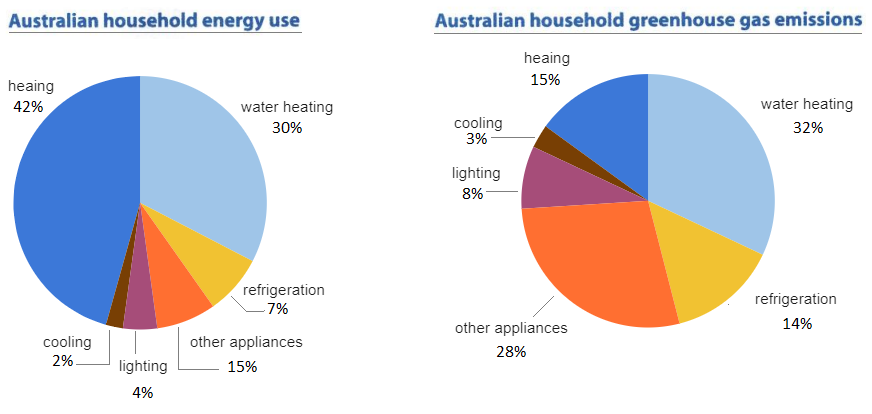
The two pie charts illustrate how average households in Australia use energy and how much greenhouse gas each type of energy consumption produces as a result.
Overall, although room and water heating consume the largest shares of energy in an average Australian house, other activities such as refrigeration and lighting create a disproportionately high amount of greenhouse gas emissions.
In detail, heating accounts for the biggest share of energy use at about 42%, yet it produces only around 15% of total greenhouse gases. Water heating requires the second-highest share of consumption (30%), and contributes close to 32% of emissions, making it one of the more significant sources. By contrast, household appliances such as refrigeration, lighting and other electrical equipment use far less energy but generate surprisingly high emissions. For instance, refrigeration uses only 7% of energy but produces about 14% of greenhouse gases. Lighting follows a similar pattern, consuming around 4% but creating nearly 8% of emissions. The category labelled “other appliances” takes just under 15% of energy use but is responsible for more than 28% of emissions, making it the single largest contributor among all categories. Finally, cooling shows a minor share in both charts. It uses only about 2% of energy and results in roughly 3% of emissions.
- 文章身份
- 机构教研范文
- 题目来源
- 教学题目