
加勒比海岛游客数量The number of tourists visiting a Caribbean island
AI 估评 7 分查看四维评分详情
四个维度等权计分,均值 7,按半分档展示。AI 估评供学习参考。
任务完成度 TA6 / 9
总量和邮轮增长更快概述正确;岛住2016下降未呈现,2017范围1.5至2含糊,称总量持续增长忽略平台,交叉时间也写得过早。
档位依据:相关概述及端点支持6档;关键平台和反转错误使其未达7档。
查看评分证据
the figure climbed again to around 1.5-2 million by 2017
岛住先降后回1.5,未升到2。
total visitor numbers rose continuously
2015至2016总量不变。
- 题图证据
已看折线:总量约1、1.3、1.5、2、2.5、2.8、2.8、3.5百万;岛住0.7、0.7、1.3、1.5、1.5、1.5、1.3、1.5;船住0.2、0.5、0.2、0.5、1、1.3、1.5、2。
改进建议
- 明确2016岛住下降、总量平台和2016邮轮首次超过岛住。
连贯与衔接 CC7 / 9
按住宿类别分段,主要信息可跟随;On the contrary用于同样上升的另一类不恰当,末尾再讲总量重复概述。
档位依据:整体组织达到7档;关系连接和重复限制8档。
查看评分证据
On the contrary, the number of cruise-ship visitors dramatically increased.
两类都总体增长,不是对前句的相反否定。
By the end of the period, the island attracted more than three times as many tourists
再次重复前述总增长信息。
改进建议
- 用Turning to cruise-ship visitors转换,将总量变化集中一次。
词汇资源 LR7 / 9
plateau、overtaking、expansion等范围充分;island-staying tourists不自然,tourism appeal把人数变化扩展为吸引力评价。
档位依据:有灵活性符合7档;搭配及精确性限制8档。
查看评分证据
overtaking island-staying tourists
应用visitors staying on the island。
a substantial improvement in the area’s overall tourism appeal
图只能显示游客数量,不能直接判断吸引力原因。
改进建议
- 采用visitors staying on the island,删去吸引力评价。
语法范围与准确性 GRA8 / 9
关系从句、过去完成比较、分词与并列结构准确,长句基本无误。
档位依据:结构范围和准确性支持8档;个别冗长总结句未达9档完全自如。
查看评分证据
more than three times as many tourists as it had in 2010
倍数和过去完成比较结构正确。
making it the larger of the two groups
分词结构准确承接分类比较。
改进建议
- 压缩重复总结句,保持准确的倍数比较。
评分日期:2026-10-23 · 评分规则:IELTS 写作公开评分标准(2023 年 5 月版)
作文题目
来源页题目,与同页选定答案配套;未核为实际考试真题
The graph below shows the number of tourists visiting a particular Caribbean island between 2010 and 2017.
Summarise the information by selecting and reporting the main features, and make comparisons where relevant.
Write at least 150 words.
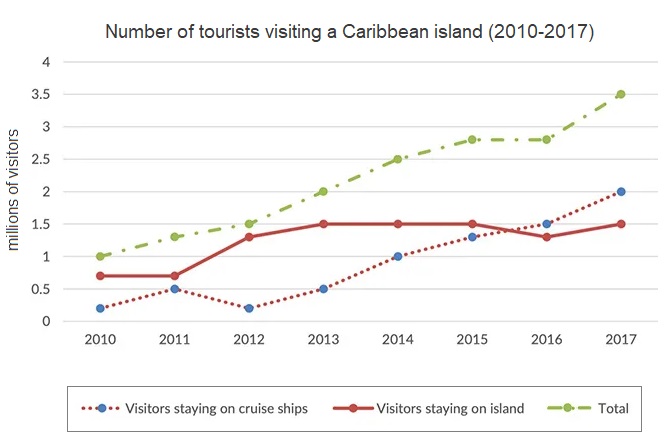
The line graph describes how many tourists visited a Caribbean island from 2010 to 2017, distinguishing between those who stayed on the island itself and those who stayed on cruise ships.
Overall, the total number of visitors to this Caribbean island increased sharply over the period, increasing from around 1 million in 2010 to approximately 3.5 million by 2017. Moreover, the number of tourists who stayed on cruise ships expanded at a notably faster rate than those who stayed on the island.
In 2010, one million travellers visited this Caribbean island, and roughly 0.75 million of them stayed on the island, while the rest stayed on cruise ships. Island-based tourism then grew gradually, reaching about 1.5 million by 2013. After a brief plateau in 2014 and 2015, the figure climbed again to around 1.5-2 million by 2017.
On the contrary, the number of cruise-ship visitors dramatically increased. After remaining relatively low until 2012, the number climbed steadily, overtaking island-staying tourists by mid-2015. By the final year, about 2 million people stayed on cruise ships, making it the larger of the two groups. As a result of growth in both categories, total visitor numbers rose continuously, with the most rapid expansion occurring between 2015 and 2017. By the end of the period, the island attracted more than three times as many tourists as it had in 2010, indicating a substantial improvement in the area’s overall tourism appeal.
- 文章身份
- 机构教研范文
- 题目来源
- 教学题目